








Employee turnover rate is the percentage of employees who leave an organization during a specific period, calculated against its average headcount. It includes voluntary and involuntary departures and helps HR teams understand workforce stability, recruitment needs, and potential retention problems.
Understanding why employees leave is just as important as measuring how often it happens. This guide explains how to calculate employee turnover rate, interpret the result, and identify practical ways to reduce avoidable departures.
What is an employee turnover rate?
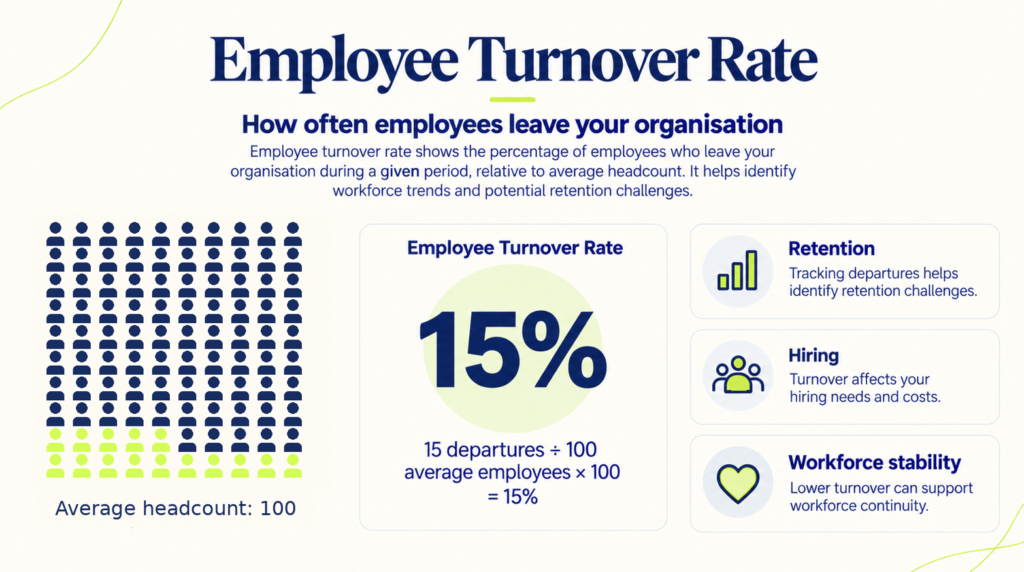
Employee turnover rate refers to the percentage of employees who leave an organization during a specific period, typically measured over a year. In simple terms, it’s how frequently employees exit your company relative to your workforce size.
This employee turnover rate definition includes both voluntary and involuntary departures, whether or not the organization replaces the employees who leave. The rate can be calculated monthly, quarterly, or annually, using departures and average headcount from the same period.
For example, a 15% turnover rate means 15 out of every 100 employees left over the measured period. This metric is also sometimes called staff turnover and is a key HR indicator of organizational health and the effectiveness of hiring and retention strategies.
Why is measuring employee turnover important?
High employee turnover can be costly and disruptive, which is why measuring it is so important. When employees frequently leave your organization, productivity suffers, team morale dips, and the company incurs significant expenses to recruit and train replacements.
By tracking your employee turnover rate, you gain insight into whether your company’s turnover is normal or a problem that needs addressing. A high turnover rate often flags deeper issues within the organization.
For instance, it may indicate problems with management, company culture, lack of growth opportunities, or inadequate compensation. On the other hand, a low turnover rate is generally a positive sign, suggesting a stable and engaged workforce and saving the company money in the long run.
Ultimately, measuring turnover empowers HR managers to identify red flags early and take action. It helps answer questions like: Are we losing people faster than we should? and What might be causing departures? With this information, you can implement targeted retention strategies before small issues become big problems, creating a more empowering and supportive work environment for your team.
How do you calculate employee turnover rate?
Calculating employee turnover is straightforward and involves a few simple steps. This employee turnover rate calculation can be done for any time frame (e.g. monthly, quarterly, or yearly) depending on what insights you need. Here’s how to do it:
1. Determine the time period
Decide if you’re measuring turnover for a month, a quarter, or a year.
2. Count the number of employees who left during that period
Count all employees whose employment ended during the period, including resignations, dismissals, redundancies, and retirements. Record departure reasons separately so you can distinguish voluntary from involuntary turnover.
For example, say 10 employees left your company during the year.
(Tip: Do not include temporary leaves like maternity or disability leave, since those employees are expected to return and not truly “lost” from the company.)
3. Find the average number of employees during the period
Add the number of employees at the start of the period to the number at the end of the period, then divide by 2. This gives you the average workforce size.
For example, if you had 100 employees at the beginning of the year and 95 at the end, the average is (100 + 95) ÷ 2 = 97.5. Keep this value unrounded during the calculation and round only the final turnover percentage.
4. Calculate the turnover rate
Divide the number of employees who left by the average number of employees, then multiply by 100 to get a percentage. Using the example above, turnover = (10 ÷ 97.5) × 100.
By following these steps, you can answer “How do I calculate employee turnover rate?” for your organization. Many HR managers perform this calculation regularly (often quarterly or annually) to keep tabs on retention. In the next section, we’ll look at the exact formula and an example to illustrate this calculation.
What is the employee turnover rate formula?
The standard employee turnover rate formula is:
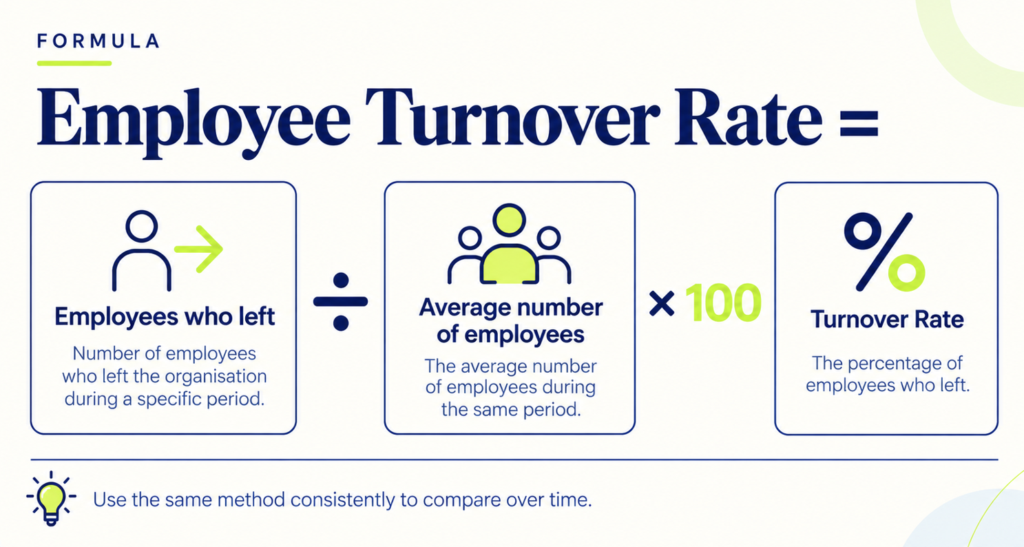
Employee turnover rate = (Employees who left during the period ÷ Average headcount during the same period) × 100.
Average headcount = (Headcount at the start of the period + Headcount at the end of the period) ÷ 2.
For example, if 10 employees leave during a period and the average headcount is 95, the turnover rate is (10 ÷ 95) × 100 = 10.53%. Use the same calculation method consistently when comparing periods.
Example: Calculating Turnover Rate
Imagine your company has 100 employees at the beginning of the month. During that month, 10 employees leave and no new employees join, leaving 90 employees at the end of the month.
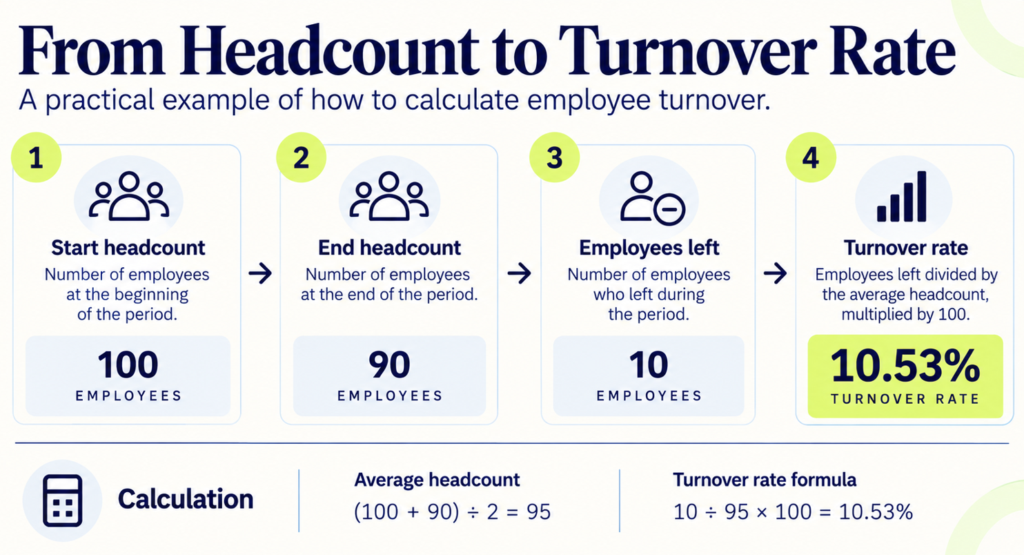
- Average number of employees (for the month) = (100 + 90) ÷ 2 = 95.
- Number of employees who left = 10.
- Turnover Rate = (10 ÷ 95) × 100 = 10.53%.
The employee turnover rate for that month is approximately 10.5%. This measures departures relative to the average workforce size during the month; it does not show whether those employees were replaced. Compare the result with other monthly figures calculated in the same way.
How do monthly and annual employee turnover rates differ?
Monthly and annual employee turnover rates use the same formula, but cover different periods. A monthly calculation uses departures and average headcount for that month. An annual calculation uses departures and average headcount across the full year. A monthly turnover rate of 10% therefore means something very different from an annual rate of 10%.
Calculate the annual rate from the underlying annual data rather than simply averaging monthly percentages. If staffing levels fluctuate substantially because of growth or seasonal work, use regular headcount observations across the period to calculate a more representative average. Apply the same measurement method consistently and explain it when comparing results.
How does high employee turnover compare with low turnover?
It’s also useful to understand high turnover vs. low turnover in practical terms. Below is a comparison illustrating how organizations with high turnover differ from those with low turnover:
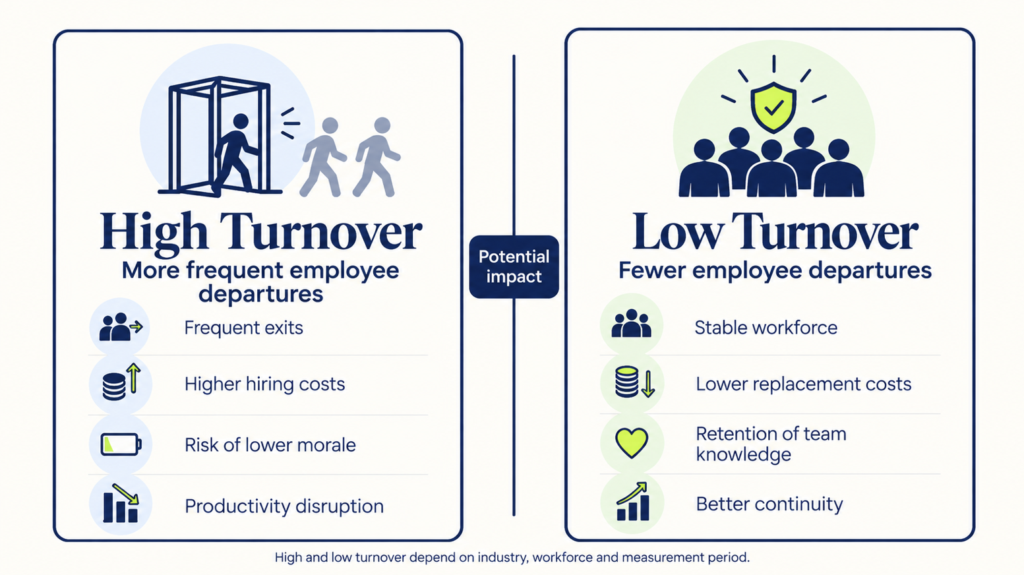
The percentages below are illustrative examples, not universal benchmarks. Whether turnover is high or low depends on the industry, location, workforce, and measurement period. Compare annual rates with annual rates and check that both figures include the same types of departure.
|
High Turnover (e.g. 20%+ annually) |
Low Turnover (e.g. 5% or less annually) |
|---|---|
| Frequent employee departures and resignations. A constant “revolving door.” | Infrequent departures; employees tend to stay with the company much longer. |
| High costs for recruiting, hiring, and training new staff to replace leavers. | Lower recruitment and training costs, saving time and money over the long term. |
| Often indicates problems such as poor morale, low engagement, management issues, or inadequate pay/benefits driving people away. | Often indicates strong employee satisfaction, good management, and effective retention strategies are in place. |
| Can disrupt teamwork, productivity, and institutional knowledge continuity, impacting overall performance. | Builds a stable, experienced team that knows the company and can be more productive and cohesive. |
Higher turnover can increase recruitment costs and disrupt continuity, but the percentage alone does not explain why employees are leaving. Lower turnover can support stability, yet it does not automatically prove that employees are satisfied. Interpret both alongside departure reasons, employee feedback, and relevant benchmarks.
What are the different types of employee turnover?
Not all turnover is the same. HR professionals distinguish between different types of turnover to better understand the nature of employee departures:
Voluntary Turnover
This is when employees choose to leave on their own. For example, an employee resigns to take a job at another company, pursue a career change, or retire. These departures are initiated by the employee’s decision. High voluntary turnover is often a sign that employees are dissatisfied with something (role, pay, culture, etc.) and can indicate deeper organizational issues if it’s widespread.
Involuntary Turnover
This occurs when employees are forced to leave the organization. Involuntary turnover includes layoffs, redundancies, or terminations due to poor performance or misconduct. In these cases, the employer makes the decision to part ways. Some involuntary turnover (like letting go of underperforming staff) can be part of normal operations, but excessive involuntary turnover might point to hiring mismatches or training issues.
Internal Turnover
Internal turnover happens when an employee leaves their current position but remains within the company in another role. For instance, an employee might transfer to a different department or get promoted to a new position.
In this case, the employee is not lost to the organization, though their old position will need to be filled. Internal turnover can be positive, as it often means you’re retaining talent and providing growth opportunities internally.
However, it still creates a vacancy that needs backfilling. (Many companies view internal transfers and promotions as a sign of a healthy talent development culture, rather than a problem.)
Internal transfers and promotions should not be counted as departures in the organization-wide employee turnover rate, because the employee remains employed by the organization. Track these movements separately when analyzing internal mobility or changes within individual departments.
External Turnover
External turnover is what we typically think of as turnover . An employee leaves the company entirely to work elsewhere or due to other reasons. External turnover counts as a departure from the organization whether the role is filled again, redesigned, or left vacant.
High external turnover is generally more concerning than internal turnover, because it means the company is losing human capital and expertise to the outside market.
Understanding these categories is useful. For example, if you notice a lot of voluntary external turnover (people quitting to join other companies), you might focus on improving internal conditions like culture or career paths.
If you have mostly involuntary turnover, you might examine your hiring process or performance management to see why so many people aren’t working out. And if you have high internal turnover, it could signal strong internal mobility (which is good) or possibly that certain departments have a habit of employees transferring out.
Breaking down turnover into types helps pinpoint the underlying dynamics behind the numbers.
How does employee turnover differ from retention and attrition?
Employee turnover measures departures during a period relative to average headcount. Employee retention measures how many employees from a defined starting group remain at the end of that period. Because the calculations can use different populations and denominators, retention is not necessarily equal to 100% minus the turnover rate.
Attrition often describes departures where positions are not filled again, although some organizations use attrition and turnover interchangeably. Define the terms used in your reporting before comparing figures across teams, organizations, or external benchmarks.
What is a good employee turnover rate?
There is no single employee turnover rate that is healthy for every organization. A useful benchmark depends on the industry, location, job type, workforce composition, and measurement period. The same annual percentage can have different implications for a seasonal business and an organization with a stable, specialized workforce.
Start by comparing your rate with previous periods calculated using the same method. Then compare it with relevant external benchmarks, checking the source, reporting year, employee population, and types of departure included. A voluntary turnover rate should not be compared directly with a total turnover rate, and a monthly rate should not be compared with an annual rate.
The reasons for departure also matter. Losing experienced employees in critical roles can be disruptive even when overall turnover is low. A higher rate following planned restructuring tells a different story from an increase in unexpected resignations. Separate these patterns before deciding which action to take.
A low turnover rate can support continuity and reduce recruitment costs, but it does not automatically demonstrate strong engagement. Combine the figure with employee feedback, internal career opportunities, and departure reasons to assess whether your retention approach is working.
How can you identify where employee turnover is highest?
Break down employee turnover by department, job role, location, and length of service to see where departures are concentrated. For each group, divide departures from that group by its average headcount during the same period. Review voluntary and involuntary departures separately, as they may require different responses.
For example, an organization-wide annual turnover rate of 10% could conceal a department with a rate of 25%. Departures concentrated in the first months of employment may prompt a review of recruitment expectations, onboarding, or early support. These patterns guide further investigation; they do not establish the cause on their own.
Check the number of departures as well as the percentage. In a small team, one departure can produce a large change in the rate. Use exit feedback and conversations with current employees to understand the context before drawing conclusions.
What are the most common causes of employee turnover?
Employees leave organizations for a wide range of reasons. Some causes are under the company’s control, while others are external. Here are some of the most common causes of employee turnover:
Inadequate Compensation and Benefits:
Unsatisfactory pay is a classic reason employees jump ship. If people feel they can earn significantly more elsewhere, or that their benefits (healthcare, vacation, etc.) are lacking, they’re more likely to leave.
Poor Management or Leadership
Employees often cite a bad manager or lack of support as a reason for leaving. A popular saying is “people leave managers, not companies.” Toxic or ineffective leadership can drive even loyal employees away.
Lack of Career Growth
When there are few opportunities for promotion, skill development, or advancement, ambitious employees may seek new jobs where they can progress in their careers. Stagnation can lead to frustration and turnover, especially among high performers.
Work-Life Imbalance and Burnout
Excessive overtime, lack of flexibility, and high stress can cause burnout. If employees feel overworked or unable to balance their job with personal life, they might leave for a role that offers better work-life balance.
Limited Training and Development
A lack of training or development programs can make employees feel like they’re not growing. When employees don’t learn new skills or see investment in their development, they may become disengaged and eventually leave.
Unclear Job Expectations or Role Confusion
If people aren’t sure what’s expected of them, or if their role keeps changing without clear communication, it creates frustration. Persistent role confusion or shifting expectations can push employees out.
Insufficient Recognition or Appreciation
When employees feel that their effort and achievements go unnoticed, they may become less engaged and more open to opportunities elsewhere. A lack of appreciation can be particularly frustrating when people consistently take on extra responsibilities without meaningful feedback or recognition.
Toxic Work Environment
A negative or toxic company culture characterized by things like workplace conflict, lack of trust, office politics, or harassment will drive turnover quickly. Employees tend to flee environments where they feel unsafe, bullied, or unhappy.
Better Opportunities Elsewhere
Even if nothing is “wrong” internally, employees might leave because they received a better offer. Competitive job markets and aggressive headhunting by other companies can lure talent away with higher salaries, promotions, or more exciting roles.
Personal Reasons
Sometimes factors outside work cause turnover. For example, an employee relocating for family, deciding to go back to school, or changing careers entirely for personal fulfillment. These reasons might not reflect dissatisfaction with the company at all, but they still contribute to your turnover rate.
It’s important to note that some turnover is inevitable and normal. Life changes and career moves will happen. However, when you see a spike in turnover, especially for negative reasons like those listed above, it’s a sign to investigate. Many of the common causes (pay, management, culture, etc.) are areas where employers can take action to improve. By conducting exit interviews or surveys, you can learn which factors are driving your employees to leave and address them proactively.
How can you reduce employee turnover?
Reducing employee turnover is all about improving the employee experience and addressing the causes of why people leave. An empowering, user-centric approach to HR will help your team feel valued and want to stay. Here are several effective strategies to reduce employee turnover:
Hire the right People from the start
Retention begins with recruitment. Ensure you’re hiring candidates who not only have the right skills but also fit your company culture.
Clearly define job roles and expectations during the hiring process so new hires aren’t surprised later. Some companies use assessments or behavioral interviews to gauge if a candidate is likely to stay and succeed.
By bringing in people who align with your mission and values, you increase the chances they’ll stay for the long haul.
Offer competitive compensation and benefits
One of the simplest ways to improve retention is to pay people what they’re worth. Regularly benchmark your salaries and benefits against industry standards to make sure you’re offering competitive packages. This includes health benefits, retirement plans, bonuses, and perks that matter to employees (like wellness programs or extra holidays).
When employees feel they’re compensated fairly (or even generously) for their work, they have fewer reasons to look elsewhere.
Provide Growth and Career Development Opportunities
Invest in your employees’ development, and they’ll invest back in your company. Create clear career paths and advancement opportunities. This could involve training programs, mentorship, tuition reimbursement, or simply new challenges that allow employees to build their skills.
When people see a future for themselves at your organization (and are learning and growing), they’re much more likely to stay rather than take their talents elsewhere. Also, consider promoting from within. It boosts morale and shows that loyalty is rewarded
Improve Management and Leadership
Because bad bosses are a common reason for quitting, work on developing strong, empathetic leaders. Train managers in people-management skills, communication, and coaching. Encourage open dialogue and make sure managers recognize and address team issues promptly.
Sometimes, reducing turnover is as straightforward as training managers to be more supportive and fair. Good leadership creates an environment where employees feel respected and motivated, which in turn boosts retention.
Foster a Positive Work Culture
Culture is a make-or-break factor. Strive to create a work environment that is inclusive, respectful, and engaging. Encourage teamwork, recognize achievements, and celebrate milestones. Even small morale boosters like team lunches, shout-outs for good work, or fun contests can strengthen an employee’s emotional connection to the company. Also, keep an eye on workload and stress: a culture that values work-life balance (for example, discouraging excessive overtime and encouraging people to use their vacations) will reduce burnout and turnover.
Encourage Work-Life Balance and Flexibility
Help employees maintain a sustainable workload through realistic priorities, adequate staffing, and clear expectations about availability outside working hours. Where the role allows, flexible schedules or working arrangements can help people balance work and personal responsibilities. Discuss which adjustments would make a practical difference and review whether they reduce recurring pressure on the team.
Listen to Employee Feedback (and Act on It)
One of the most user-centric things you can do as an employer is to regularly seek and respond to feedback from your team. Conduct stay interviews (informal chats to ask employees what’s going well and what could be better), run anonymous surveys, or have an open-door policy. The key is to find out what matters to your employees and if they have any concerns that might push them to leave. Maybe they want more flexible vacation policy, or they feel career progression is unclear. Whatever it is, take it seriously. When employees see that you listen and make improvements based on their input, trust increases and turnover decreases.
Recognize and Reward Employees
A little appreciation goes a long way. Implement programs to recognize employees for their hard work. Whether it’s a formal rewards program or just a culture of saying “thank you.” Acknowledge milestones like work anniversaries or successful project completions. When people feel valued and appreciated, they are far less likely to seek that validation elsewhere.
Use reliable HR and payroll data
Reliable turnover reporting starts with consistent employee records. When combining HR and payroll data, align employee identifiers, employment start and end dates, departure reasons, and department assignments. Preserve historical information so that each departure is counted in the correct reporting period and organizational unit.
For example, a final payroll payment after someone leaves should not automatically make that person appear active in the headcount. Similarly, an internal transfer should not create an additional departure in the organization-wide turnover calculation. Agree on these reporting rules before automating dashboards.
Analytics can help teams identify patterns and investigate unusual changes, but a pattern does not establish why someone left or predict an individual’s intentions with certainty. Use findings alongside employee feedback and human judgment to decide where support or process improvements are needed.
By implementing these strategies, you create an empowering environment where employees feel heard, challenged (in a good way), and rewarded. Many of these changes, from better communication to flexible work options are low-cost or minimal effort but can dramatically improve how people perceive their job.
Some departures can be prevented, while others reflect personal decisions or circumstances beyond the employer’s control. Focus retention efforts on the factors your organization can influence, such as workload, management support, recognition, and career development. Review the results over time rather than assuming that every initiative will have the same effect.
In conclusion, managing your employee turnover rate is about understanding it and then taking action. Start with a clear definition and accurate calculation of your turnover rate, recognize its importance as a barometer of organizational health, and break down what type of turnover you’re seeing. Keep an eye on whether your rate is in a healthy range or signaling trouble, and most importantly, tackle the root causes with thoughtful, modern HR strategies.
By doing so, you’ll not only reduce costly turnover but also build a more engaged, loyal, and high-performing team. Which is a win-win for your employees and your business.
FAQ
Employee turnover rate can exceed 100% when the number of departures during a period is higher than the average headcount. This can happen when positions are filled and vacated repeatedly. For example, 60 departures during a year with an average headcount of 50 produces an annual turnover rate of 120%.
Employees who join and leave within the reporting period count as departures, provided they belong to the employee population being measured. Include them even if they were not employed at the beginning or end of the period. Where this happens frequently, use regular headcount observations to calculate a more representative average.
The standard employee turnover rate uses headcount rather than full-time equivalents (FTE). Headcount measures people, while FTE measures working capacity. A part-time employee therefore counts as one person in both the departure count and the relevant headcount observations. Dividing the number of people leaving by an FTE denominator mixes different units and can distort the result.
A rolling 12-month employee turnover rate measures departures over the most recent 12 months, updating the reporting window each month. Divide departures during those 12 months by the average headcount for the same period, then multiply by 100. This provides an ongoing annual view and helps put short-term fluctuations into context.
A company can grow despite high turnover if it hires more employees than it loses. For example, a company that hires 40 people and records 25 departures increases its headcount by 15, assuming no other changes. Headcount growth therefore does not necessarily indicate strong retention: review hiring and departures separately.