







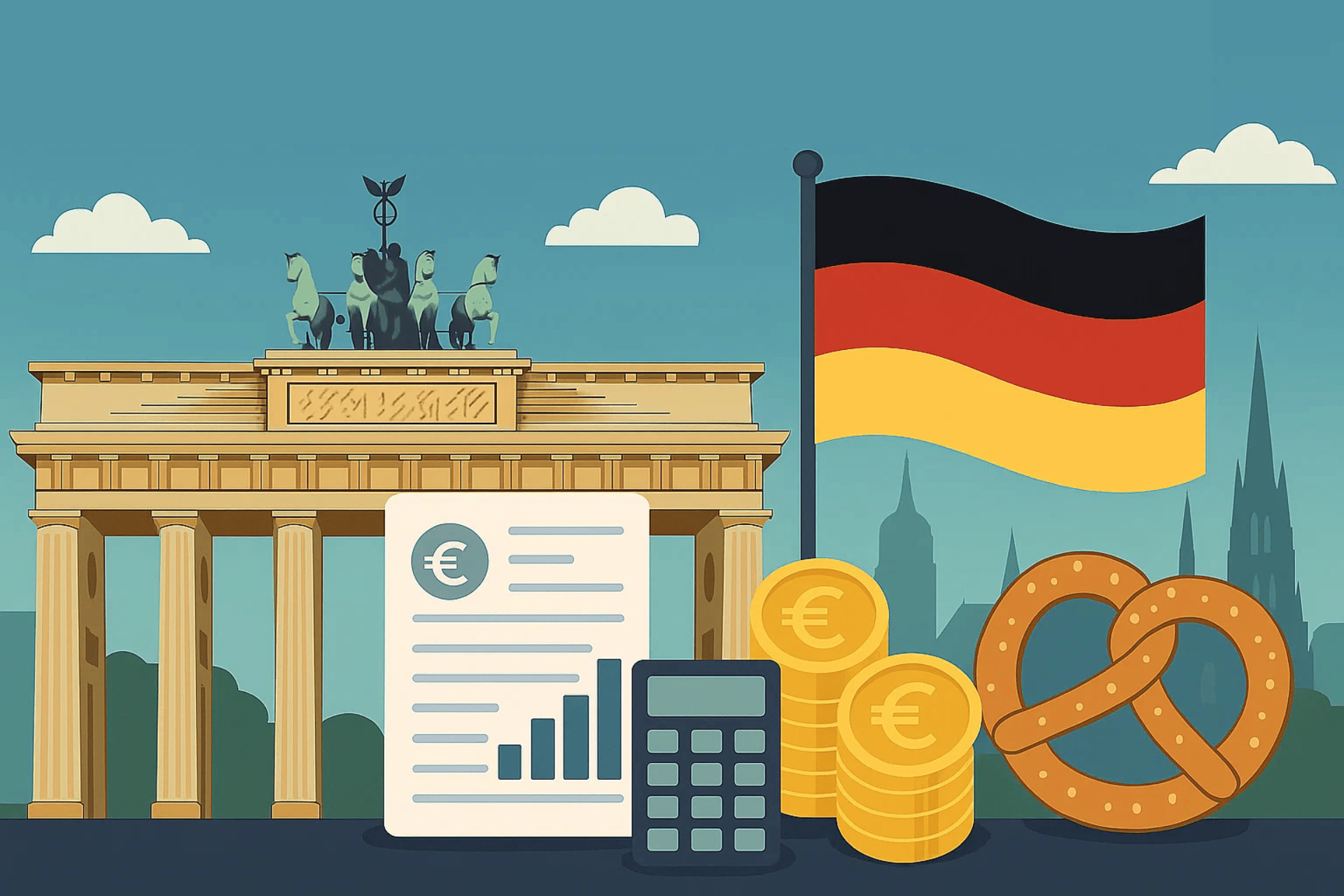

In this German payroll Guide, we explain the most important differences, giving you the most complete possible overview of everything you need to consider in German HR and payroll administration.
Do you still have questions after reading this handbook? Let us know. We’ll be happy to help you set up your German HR and payroll in the best possible way.
1. EMPLOYMENT CONSIDERATIONS
Collective labor Agreements, trade Unions, labor Laws and Laws on employment Contracts
Collective Labour Agreements (CBA’s)
Unlike in the Netherlands, most employment sectors in Germany do not have generally binding collective labour agreements (CBA’s). We recommend checking whether a CBA applies to your specific industry.
Trade Unions
Germany has trade unions that represent the collective interests of employees. The largest of these is the Deutsche Gewerkschaftsbund (DGB). Employers’ associations, in turn, safeguard the interests of employers.
Labour legislation
Labour legislation in Germany is somewhat complex. Instead of one overarching labour law, various laws apply. The most important are:
- The Civil Code BGB (Bürgerliches Gesetzbuch);
- The Employment Protection Act KSchG (Kündigungsschutzgesetz)
- The Part-Time and Fixed-Term Employment Act TzBfG (Teilzeit- und Befristungsgesetz);
- The Works Constitution Act BetrVG (Betriebsverfassungsgesetz);
- The Minimum Wage Act MiLoG (Mindestlohngesetz);
- The Gewerbeordnung (GewO) , the German Trade Regulation Act.
Note: For cross-border employment relationships between employees and employers in countries within the European Union, Regulation (EC) No. 593/2008 Rome I also applies.
Employment Contract Laws
When it comes to concluding employment contracts, Germany has the following options and practices:
Permanent contract (unbefristeter Arbeitsvertrag)
The most common type of contract is one for an indefinite period. An employee who currently holds a permanent contract and resigns for a new job will usually expect a permanent contract from their future employer as well. In most cases, both parties agree to the maximum possible probation period of 6 months.Fixed-term contract (befristeter Arbeitsvertrag)
Less common is a fixed-term contract. There are two variants:a fixed-term contract without specific reason (ohne Sachgrund), and
a fixed-term contract with a specific reason (mit Sachgrund), such as project work or seasonal employment.
The conditions for this can be found in the TzBfG (Teilzeit- und Befristungsgesetz). For example, Section 14.2 states that an employee may be employed on a fixed-term basis for a maximum of two years. Within this two-year period, the contract may be extended up to three times.
On-call contracts (Arbeit auf Abruf)
German law also allows for on-call contracts between employer and employee, but certain legal requirements apply when concluding such contracts.Temporary agency work (Arbeitnehmerüberlassung)
Employment contracts with temporary agency workers are subject to stricter rules than the above-mentioned contract types. These can be found in the German Temporary Employment Act Arbeitnehmerüberlassungsgesetz (AÜG). For example, you must apply for a temporary employment license (see Article 1).Secondment agreement (Entsendung)
A secondment agreement can be concluded if you want one or more of your Dutch employees to work in Germany, for example at your German subsidiary (GmbH). In this case, you must take the existing employment contract into account.
For secondment of employees, both in the Netherlands and Germany, the European Directive 2018/957 applies. The aim of this directive is to protect posted workers during their assignment.
In addition to this EU directive, you must also comply with the German Posting of Workers Act AEntG (Arbeitnehmer-Entsendegesetz), the Minimum Wage Act MiLoG (Mindestlohngesetz, see also the information in chapter 2), and the resulting regulations.
Regulations for International Employees
Cross-border employment relationships involve many complications for employers. Among other things, strict (EU) regulations apply (see below).
If you hire an employee to work, for example, both in the Netherlands and Germany, the applicable rules depend on several factors:
the country where the employee resides,
how much of their time they spend working in each country,
the country where the employer is registered, and
whether the employment is temporary (limited) or for an indefinite period.
The answers to each of these options determine which labor law applies (i.e., that of the Netherlands or Germany), but also where the employee pays tax on the services provided and which social security system he or she falls under.
Applicable (EU) regulations:
Regulation on employment law
In some cases, it may be useful to include a choice of law in the employment contract. The consequences of such a choice of law and whether it makes sense to agree on it can differ per case. The EU Regulation Rome I (EC 593/2008) applies here.
Tax Treaty Germany – Netherlands
To prevent international employees in the Netherlands and Germany from having to pay tax on the same income in both countries, the tax treaty between the Netherlands and Germany determines which country has the right to levy taxes.
The main rule: taxation is carried out by the employee’s country of residence, unless he/she performs the employment in the country of work (see Article 14 paragraph 1). However, exceptions apply. For example, if the employee earns income in the “work state” for a maximum of 183 days per year. This may occur in the case of a temporary secondment.
Social Security
The employee must comply with the social security obligation in one of the two countries. In principle, the employee is socially insured in the country where he works (where he actually performs the work). Naturally, exceptions exist, for example in the case of temporary secondments. Everything concerning this is set out in EU Regulation 883/2004.
Our advice:
As an employer, assess the situation before the start of the employment and/or secondment. If you take the relevant steps at that moment, you will avoid possible surprises (such as retroactive payments in the other country).
Hiring Employees
When hiring employees in Germany, there is quite a bit of paperwork involved. What do you need when hiring employees in Germany:
First, see the applicable laws on employment contracts.
An employment agreement.
Explanation: such an agreement can be concluded informally, either verbally or in writing. However, do pay attention to the requirements of § 2 of the Nachweisgesetz (German documentation law for an employment relationship): the parties involved must record certain agreements in writing, such as each party’s names, address, and the start date of employment.
Our advice: choose a written employment agreement, in which both parties clearly record the agreements made.
Documents for payroll administration.
An intake form with personnel data such as name, address, place of residence, the German BSN of the employee (their tax identification number, FIN), and their German health insurance (Krankenkasse).
An official certificate of the employee’s German health insurance.
The contract of the company pension scheme (betriebliche Altersvorsorge, bAV).
A disability certificate.
- With a so-called Schwerbehindertenausweis, an employee with a disability can claim “compensation for disadvantages.” Depending on the severity of the disability, this may take the form of, for example, extra dismissal protection and vacation days.
- In case of a company car (not mandatory, but more common than in the Netherlands):
a written confirmation from the car dealer with the gross catalog value of the car (for payroll processing and as proof in the event of possible inspection by the German tax authorities).
a regulation you have drawn up regarding the use of the car, signed by both employer and employee.
DURATION OF WORK WEEK
A full working week in Germany lasts 35 to 40 hours, depending on the sector and applicable collective labour agreement. In general, employees work 40 hours per week.
2. Salaries, termination and Pensions
Salaries
The minimum wage
Every employer, both domestic and foreign, is obliged to pay their employees working in Germany the German statutory minimum wage. This applies to all work performed in Germany (including short-term work). The current minimum wage can be found in the Bundesgesetzblatt, the German Federal Law Gazette.
An important requirement in personnel administration in certain sectors (for example, the hospitality and construction industries) is that the employer must keep time records. This means recording the start, end, and duration of the work, no later than seven days after the work has started. This may be done either on paper or digitally. The records must comply with the German Minimum Wage Act (MiLoG). The employer must then keep this data for two years (we recommend keeping it even longer), in order to present it in the event of an inspection by German customs, the German tax authority, or other institutions.
Exceptions: In some sectors, the negotiated minimum wage is higher than the statutory minimum. This wage takes precedence over the generally applicable minimum wage. However, it is valid only for a limited period of one to three years. After that, the relevant industry organization must renegotiate the minimum wage with the trade unions.
Compliance with the Minimum Wage Act by foreign employers is monitored by the customs department Financial Control of Illegal Employment (Finanzkontrolle Schwarzarbeit).
Monthly Payments
You must prepare the payslips on a monthly basis: Germans do not have four-weekly pay periods. Payment is made directly by the employer, without the involvement of third parties.
Salary components:
hourly wage, monthly salary, or annual salary
compensation according to the collective labour agreement
piecework pay (Akkordvergütung)
performance-based pay (commission or profit sharing)
compensation for overtime worked
allowances, for example for night shifts or work on Sundays and public holidays
additional (not legally required but common) allowances such as a thirteenth month or holiday allowance
possible bonuses (varying individually by sector and the employee’s position)
Payment of overtime
Only overtime worked following the employer’s instructions or with their approval must be compensated. This can be done either through monetary payment or by granting time off in half-days or full days. It is also possible to include overtime payment in advance in the salary, provided both parties have agreed on a certain upper limit. Compensation for overtime (whether or not estimated and included in the monthly salary) must by definition comply with the minimum wage.
Our advice: During negotiations, discuss whether overtime worked will be converted into time off or paid out (possibly with an additional allowance), and include this in the employment contract.
TERMINATION
Termination of the contract
Ending an employment contract can take place in the following ways, in compliance with the Employment Protection Act KSchG (Kündigungsschutzgesetz) and the Gewerbeordnung (GewO, the German Trade Regulation Act):
By operation of law. This can occur when a fixed-term employment contract expires, when the employee reaches retirement age (provided the employment contract contains a clause about this), or in the event of death.
By mutual agreement. This happens through signing a negotiated termination agreement (Aufhebungsvereinbarung).
Unilaterally by written notice of termination from the employee or employer.
Note: a termination given orally, by e-mail, or via fax is not legally valid.
Unlike in the Netherlands, you do not need to submit a written dismissal application in advance to the German Employment Agency BA (Bundesagentur für Arbeit, comparable to the Dutch UWV). This obligation does apply in the case of special groups of employees: severely disabled persons, pregnant employees, employees on maternity or parental leave, and members of the works council.
Reference letter
Upon termination. Whether initiated by the employee or given by the employer. The employer is obliged to hand over a written reference (Arbeitszeugnis) to the employee. The conditions this reference must meet can be found in §109 of the GewO.
If the employee personally requests this reference, they expect you to also evaluate their performance and conduct in the workplace.
Writing such a reference requires great care: both the employee and potential future employers will “read between the lines.” You must (!) use positive wording, from which the discerning reader can nonetheless deduce the degree of appreciation for the employee. The following are the customary formulations, ranging from very positive to highly critical:
- “Stets zu unserer vollsten Zufriedenheit.” (Very good.)
- “Stets zu unserer vollen Zufriedenheit.” (Good.)
- “Zu unserer vollen Zufriedenheit.” (Satisfactory.)
- “Zu unserer Zufriedenheit.” (Adequate.)
- “Im Großen und Ganzen zu unserer Zufriedenheit.” (Insufficient.)
- “Er hat sich bemüht, die ihm übertragenen Aufgaben zu unserer Zufriedenheit auszuführen.” (Severely inadequate.)
Vacation days
Upon termination of the employment contract, the employer must issue a statement showing the vacation days taken during that year, for the benefit of the next employer. If an employee dies, the heirs are entitled to compensation for the remaining vacation days.
Severance Pay / Transition Compensation
For severance or transition compensation, an employee under 50 years of age is entitled to a maximum of twelve times the salary that he would have earned, based on the regular working hours, in the full month in which the dismissal takes effect. For employees aged 50 and older, and depending on the length of service, this can increase to a maximum of eighteen times this monthly amount. See paragraph 10 of the Employment Protection Act (KSchG).
In contrast to the Netherlands, a German employee is also entitled to unemployment benefits after voluntary resignation. However, a so-called sperrzeit (waiting period) of three months applies before the former employee receives this benefit. When drafting the termination agreement, including a notice period can help to limit these consequences.
Our advice: when preparing for a dismissal, involve a German lawyer—especially in the case of cross-border employment relationships.
Pension Accrual
Germany, like the Netherlands, has a multi-layered pension system.
First, there is the statutory old-age pension (Altersrente, the German equivalent of the Dutch AOW). The contributions for this are paid half by the employer and half by the employee.
In addition, many employers offer their employees a company pension scheme: the betriebliche Altersvorsorge, an insurance agreement between employee, employer, and insurance company.
The amount that must be deducted from the salary (tax-free up to a certain limit) varies per insurance company. Upon reaching retirement age, the employee receives this pension either as a lump sum or in monthly payments, depending on the scheme.
For contracts concluded from 2005 onwards, the employee pays their monthly pension contribution tax-free. After retirement, they pay tax on their benefits.If an employer does not offer a company pension scheme, for example due to a small workforce, the employee can take out a “private” old-age insurance policy. The procedure is the same as with a collective scheme. The employer is obliged to cooperate with this.
3. Taxes and Social Insurance
Unlike the Netherlands, Germany does not have combined wage tax. The employer remits the wage tax withheld from the employee’s salary to the Finanzamt (the German tax authority). This must be done no later than the tenth day of the following month.
Another part of the salary is used, together with the employer’s share, to pay the statutory social security contributions to the Krankenkasse (health insurance fund). Employee and employer each pay approximately half of each contribution amount. The employer must pay the social security contributions no later than the third-to-last banking day of the worked month.
Wage Tax
The following taxes are part of the wage tax in Germany.
Individual wage tax
The advance tax on income tax (Einkommensteuer)
The church tax (Kirchensteuer) for all members of recognized churches. This amounts to 8 to 9 percent of the gross monthly salary, depending on the federal state where the employee resides.
Cross-border workers from the Netherlands do not have to pay Kirchensteuer.
The solidarity surcharge (Solidaritätszuschlag), serving for the reconstruction of the former East German federal states. As of 2021, this tax has been partially abolished, but under certain circumstances it still applies. It amounts to 5.5 percent of the gross monthly salary.
Tax Classes (Steuerklassen)
The marital status and the number of children of the employee influence income tax. The Income Tax Act distinguishes six so-called Steuerklassen to categorize each employee.
Single Tax Rate
The German tax authority (Finanzamt) does not use a box system, as in the Netherlands. All income of the taxpayer falls under the same tax rate. The only exception is income from investments. (For this income, taxpayers in Germany pay a flat tax of 25 percent, or, optionally, a personal tax rate.)
Deductions
When determining taxable income, the employee is entitled in their income tax return to a fixed, flat-rate deduction of 1000 euros per year. If their existing deductions exceed this amount (such as unreimbursed work-related travel expenses, bank charges, and certain insurance costs), they are entitled to the relevant higher amount.
Tax Rates
The German Finanzamt works with five progressive tax zones:
Tax zone 1: zero zone with tax-free basic allowance (Grundfreibetrag); in 2021 €9,744;
Tax zone 2: progressive rates I, starting from 14 to 24 percent;
Tax zone 3: progressive rates II, starting from 24 to 42 percent;
Tax zone 4: proportional (fixed) tax rate I of 42% (Spitzensteuersatz);
Tax zone 5: proportional (fixed) tax rate II of 45% (Reichensteuer).
Tax Liability
Unlimited tax liability (unbeschränkt einkommensteuerpflichtig)
Every resident of Germany in their country of residence, according to § 8 of the German Tax Ordinance (Abgabenordnung).
An employee who stays in Germany for longer than 6 months, according to § 9 of the Abgabenordnung.
Upon request, an employee living abroad may apply for unlimited tax liability if 90% of their worldwide income is taxed in Germany, or if their non-German income is lower than the Grundfreibetrag in that calendar year (see above under Tax Rates).
Employees from abroad who, after applying for a tax class (Steuerklasse), are placed in tax class 3.
Limited Tax Liability (beschränkt einkommensteuerpflichtig)
An employee who has neither residence nor ordinary place of abode in Germany.
An employee with a cross-border employment relationship. In that case, it may (at their own discretion) be worthwhile for the employee to file an income tax return in both Germany and the Netherlands. See also Regulations for international employees (Chapter 1).
Social Security Contributions
In addition to wage tax, the employer, as mentioned earlier, must pay the employee’s share of social security contributions to their Krankenkasse. These include the following insurances:
Health insurance (Krankenkasse)
Germany has more than 120 different Krankenkassen. The employee decides with which one they insure themselves. In addition to these statutory health insurances (gesetzliche Krankenversicherungen, comparable to the former public health insurance fund in the Netherlands), Germany also has private health insurances (Privatversicherungen). Employees with an above-average income are free to choose the private option (with its associated privileges).
Long-term care insurance (Pflegeversicherung)
The statutory Pflegeversicherung can be compared with the former Dutch AWBZ and its successor, the current Long-Term Care Act (Wet langdurige zorg). It covers exceptional medical expenses such as long-term admission to a nursing home.
Accident insurance
Every employer is obliged to insure their employees against, among other things, (fatal) occupational accidents and work-related illnesses. This must be done through one of the nine trade associations (Berufsgenossenschaften) of the DGUV (Deutsche Gesetzliche Unfallversicherung).
The trade associations manage insurance against incidents such as:
occupational accidents during working hours;
accidents during business trips;
commuting accidents (concerning logical routes).
The trade associations also handle benefits such as:
an accident pension;
a widow’s and orphan’s pension;
a death and survivor’s benefit;
travel expenses for medical examinations and employee contributions for medication.
Pension insurance (Rentenversicherung)
This premium concerns the statutory compulsory regular pension scheme, comparable to (though higher than) the Dutch state pension (AOW). In addition, German employers also offer supplementary schemes; see this information on pension schemes.
Unemployment insurance (Arbeitslosenversicherung)
Due to the insurance rights of every employee, employers are required to pay the Arbeitslosenversicherung premium monthly to the federal employment agency Bundesagentur für Arbeit (BA), comparable to the Dutch UWV.
You can read more information about the social security obligations of cross-border workers here.
4. LEAVE REGULATIONS
Vacation days and other days off
With a six-day workweek, the employee is entitled under the Federal Vacation Act BUrlG (Bundesurlaubsgesetz) to 24 vacation days per year. Those who work five days per week (the most common) are entitled to 20 vacation days per year. However, under most Tarifverträge (collective agreements), employees are entitled to 24 to 30 vacation days.
An employee has the right to take at least two consecutive weeks of vacation days (twelve for a six-day workweek, ten for a five-day workweek) (§7 BUrlG). Sundays and public holidays are not counted as working days.
During vacation days, the employer continues to pay the usual wages, without additional (expense) allowances. According to §11 of the BUrlG, the average wage of the employee during the 13 weeks preceding the vacation is to be paid, excluding any overtime worked and including commissions and allowances such as night shift premiums during that period.
Expiration of unused vacation days. According to many employment contracts, vacation days automatically expire at the end of the year and at the latest in March of the following year. However, according to the European Court of Justice, the employer is obliged to request the employee in writing, before the expiration date, to take the remaining vacation days. The employer must clearly indicate how many vacation days the employee still has, and that they will expire if not taken in time. The employer bears the burden of proof for this.
Sundays and Public Holidays
Employees also have a constitutionally guaranteed right to a paid day off on Sundays and public holidays.
The public holidays differ per federal state. The only national holiday is German Unity Day on October 3. In addition, eight other holidays apply in all sixteen federal states: New Year’s Day, Good Friday, Easter Monday, Labour Day (May 1), Ascension Day, Whit Monday, and both Christmas Days. This website provides an overview of all holidays, federal and per state.
The actual place of work of the employee determines which public holidays apply to him or her, regardless of home address or company address.
If the employee works from home (home office), the public holidays of their place of residence apply.
Holiday Allowance
Unlike continued payment of wages during vacation days (Urlaubsentgelt), Germany has no statutory obligation to pay a holiday allowance (Urlaubsgeld). However, most collective agreements, and sometimes also employment contracts, contain provisions for this.
Continued Payment of Wages during illness
From the moment an employee reports sick, he is entitled to his full gross salary for the first six consecutive weeks (see the Continued Payment of Wages Act EntgFG (Entgeltfortzahlungsgesetz)). After that, the employee receives sickness benefit from the Krankenkasse (70 percent of the gross salary, and a maximum of 90 percent of the net salary).
If the incapacity for work lasts longer than three calendar days, the employee must submit a doctor’s certificate (Arbeitsunfähigkeitsbescheinigung, commonly called gelber Schein) to the employer no later than the fourth day.
Maternity Leave
Based on the so-called general employment ban, a pregnant employee is not allowed to work during the last six weeks before the expected due date.
After the actual date of birth, a female employee may also not work during the first eight weeks. In the case of premature birth and/or multiple births, this ban extends to twelve weeks.
During this period, the employee receives €13.00 per calendar day from her Krankenkasse; the employer supplements the remaining amount up to the level of her net salary.
During maternity leave, the employee continues to accrue vacation days.
PARENTAL LEAVE
- Employees in Germany, both partners, are entitled to unpaid parental leave (Elternzeit) after the birth of their child. All provisions for this are laid down in the Federal Parental Allowance and Parental Leave Act BEEG (Bundeselterngeld- und Elternzeitgesetz). This right also applies to Dutch cross-border workers to whom German labour law applies.
The employee must submit their request for parental leave to their employer in writing, at least seven weeks before it begins. For the pregnant employee, Elternzeit starts at the earliest immediately after her paid maternity leave.
This unpaid leave lasts up to the child’s (or children’s, in the case of multiples) third birthday. In consultation with the employer, the employee may save up to 24 months of Elternzeit and take it between the child’s third and eighth birthday.
For each child, parents are again entitled to three years of unpaid parental leave. If leave periods overlap due to one or more subsequent births, parents (in coordination with their employer) can take the remaining entitlement for each child until their eighth birthday.
From eight weeks before the start of this parental leave, the employee enjoys protection against dismissal. After the leave, he or she has the right to return to their former or an equivalent position.
During this unpaid parental leave, the employee may apply to the government for Elterngeld, a parental allowance available for twelve to fourteen months. An overview of the variants can be found here.
During this parental leave, the employee is free to continue working part-time for up to 30 hours per week. This is possible if the employee opts for Elterngeld Plus. Certain conditions apply to this. The employer must pay these hours worked according to the previously applicable salary.