








The employee lifecycle describes the key moments an employee moves through, from attraction and recruitment to onboarding, development, retention, offboarding, and advocacy. For HR and payroll teams, it also works as a practical map of important records, approvals, and data handoffs that connect HR decisions to payroll, tax, benefits, and compliance outcomes.
Managing the employee lifecycle well helps organisations create a better employee experience, reduce avoidable errors, improve data quality, and make each stage of the employee journey easier to manage. Each change that affects pay should be recorded with a clear effective date, a responsible owner, and the right approval so systems can apply the correct calculations and managers know who needs to act.
This article explains what the employee lifecycle is, why it matters, the seven core stages, how the model compares with more detailed 11-stage models, and how HR and payroll teams can use lifecycle data to reduce delays, corrections, and compliance risk.
What is the employee lifecycle?
The employee lifecycle, often shortened to ELC, is a model that maps the full journey an individual takes with an organisation. It starts before employment, when a candidate first becomes aware of the employer, and continues through recruitment, onboarding, development, retention, offboarding, and post-employment advocacy.
HR teams use the employee lifecycle to understand and improve each phase of the employee experience. Much like a customer lifecycle helps teams understand a buyer’s journey, the employee lifecycle helps HR teams see how people experience work from the first impression to long after they leave.
From an operational perspective, the employee lifecycle is also a practical view of the events and changes that happen during someone’s time with an organisation. Some of these events, such as hiring, promotion, salary change, benefits enrolment, working pattern change, or exit, create important payroll inputs. Each payroll-relevant event should have a clear owner and source, a recorded effective date, and the right approval or supporting evidence.
Who created the employee lifecycle model?
The employee lifecycle model is not usually attributed to one single inventor. It developed as HR thought leaders and consultancies began applying customer experience thinking to employees. The core idea is simple: employees move through a journey with distinct phases, and each phase can be managed, measured, and improved.
Different organisations use different versions of the model. Some use five or six broad stages, many use a seven-stage model, and larger organisations may use more detailed models with ten or eleven stages. The purpose remains the same: to view the employment relationship as a connected journey rather than a set of isolated HR processes.
Why is the employee lifecycle valuable in modern HR?
The employee lifecycle is valuable because it gives HR teams a clear framework for improving the full employee experience. By understanding each stage, organisations can identify where employees need better support, where managers need clearer responsibilities, and where systems or processes create unnecessary friction.
A well-managed lifecycle helps HR move from isolated activities to a connected hire-to-retire strategy. Recruitment, onboarding, development, retention, offboarding, payroll, benefits, IT access, and compliance all become part of one joined-up employee journey rather than separate processes managed in different places.
Improved employee experience
Monitoring and improving each lifecycle stage helps employees have a more consistent experience before, during, and after their time with the organisation. A clear recruitment process, structured onboarding, meaningful development, timely role changes, and respectful offboarding all contribute to stronger job satisfaction and a better employer brand.
For employees, the value is practical. They know what to expect, receive the right information at the right time, and experience fewer delays or errors when important changes happen. For HR teams, this makes it easier to identify pain points and improve the moments that matter most.
Higher engagement and retention
A strong lifecycle approach helps organisations meet employee needs at each stage. When employees feel supported, paid correctly, recognised, and able to grow, they are more likely to stay engaged and committed to the organisation.
Lifecycle data can also help HR identify retention risks earlier. For example, recurring issues in onboarding, slow promotion processing, unclear development paths, or repeated payroll queries may all signal friction that could affect engagement and retention.
Better performance and productivity
When HR and managers proactively support employees through onboarding, development, feedback, recognition, and career milestones, employees are more likely to perform well and build the skills the organisation needs.
A lifecycle perspective also helps teams spot operational gaps. If new hires take too long to become productive, if role changes are delayed, or if experienced employees feel stuck, HR can investigate the relevant lifecycle stage and take targeted action.
Strategic HR and payroll alignment
The employee lifecycle also helps HR, payroll, finance, IT, and compliance teams work from the same map. Each important lifecycle event, such as hiring, onboarding, promotion, salary change, benefits enrolment, working pattern change, or exit, can create records that affect pay, tax, benefits, access, and reporting.
When these events are recorded with a clear owner, authoritative source, approval route, and effective date, teams can reduce repeated pay errors, improve compliance reporting, and avoid unnecessary corrections after payroll processing.
In short, the employee lifecycle model helps HR teams become more intentional and proactive. It supports better employee experience, stronger engagement, improved performance, clearer ownership, and more reliable HR and payroll operations.
What does the employee lifecycle mean in everyday work?
The employee lifecycle is not only a model for HR strategy. It is also the practical journey an employee experiences from the moment they are considered for a role to the moment they leave the organisation. For employees, this journey affects whether their first day feels organised, whether their pay is correct, whether changes in their role are handled smoothly, and whether their exit is managed clearly and respectfully.
For managers, the employee lifecycle clarifies what needs to happen at each stage. A new hire needs the right information in place before they start. A promotion needs the right approval and effective date. A leaver needs a clear final pay process. Good records and clear handoffs matter, but the purpose is simple: helping people move through key work moments with fewer mistakes and less friction.
In this sense, the employee lifecycle is both an operational framework and an employee experience tool. It helps teams connect people processes, payroll requirements, system updates, and manager actions into one more consistent way of working.
Why do employee lifecycle stages matter?
Employee lifecycle stages matter because they define when important records are created, validated, approved, and handed to payroll. Mistakes early in the flow can replicate across pay runs, create employee dissatisfaction, and increase the need for corrections.
For example, a missing effective date on a salary change can cause an underpayment, overpayment, or retroactive adjustment. A late leaver notification can result in final pay errors or continued access to systems after employment has ended.
Clear lifecycle stages help HR, payroll, finance, managers, IT, and compliance teams understand who owns which action, which system should hold the source data, and what evidence is needed before a change is processed.
The 7 Stages of the Employee Lifecycle
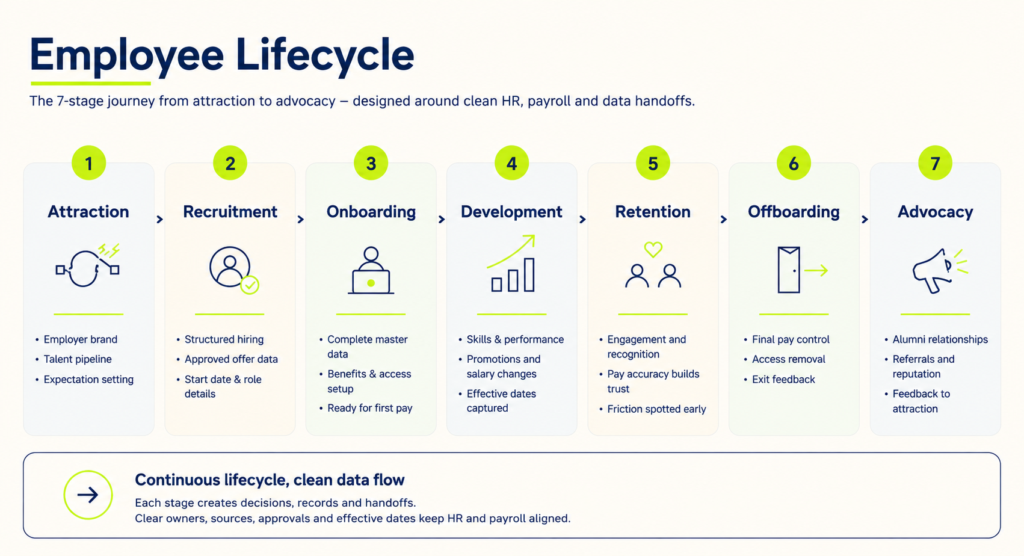
While variations of the employee lifecycle exist, many HR teams use a seven-stage model that covers the journey from attraction to advocacy. The seven core stages are attraction, recruitment, onboarding, development, retention, offboarding, and advocacy.
Each stage represents a different phase in the employee’s relationship with the organisation. For HR and payroll teams, these stages are also important because they create records, approvals, effective dates, and data handoffs that can affect pay, tax, benefits, compliance, access, reporting, and the employee experience.
A strong employee lifecycle is therefore not only about creating a positive journey for employees. It is also about making sure each payroll-relevant event has a clear owner, one authoritative source, the right approval, and a recorded effective date.
Stage 1: Attraction
Attraction is the first stage of the employee lifecycle. It begins before any formal application or interview takes place. At this stage, potential candidates form an impression of the organisation as a place to work. This impression can come from the company website, social media, job boards, employer review sites, employee stories, word of mouth, or the wider customer-facing brand.
Attraction is closely connected to employer branding. HR and marketing teams often work together to communicate the company’s culture, values, mission, benefits, and employee experience. A strong attraction stage helps create a pipeline of people who already view the organisation positively before a vacancy opens.
From a data and payroll perspective, attraction does not usually create direct payroll inputs yet. However, it influences later stages by setting expectations around role type, location, flexibility, benefits, culture, and reward. Clear and realistic employer branding can reduce mismatched expectations once a candidate becomes an employee.
Stage 2: Recruitment
Recruitment is the stage where the organisation actively finds, evaluates, and hires new employees. It includes job postings, sourcing, screening, interviews, assessments, candidate communication, selection, and offer acceptance.
A strong recruitment process is fair, structured, efficient, and transparent. Clear job descriptions, trained hiring managers, timely communication, and consistent interview criteria help organisations find qualified people while protecting the employer brand.
Recruitment also creates important operational records. These can include the job offer, working pattern, probation terms, pay basis, expected hours, location, employment type, and start date. If these details are missing or unclear, HR and payroll teams may need to make assumptions later, which can increase the risk of retroactive corrections. A useful control is to require approved offer fields before payroll setup begins.
Stage 3: Onboarding
Onboarding covers the period after hiring, when a new employee joins and settles into the organisation. It starts after offer acceptance and often continues through the first weeks or months. Effective onboarding helps new employees feel welcomed, prepared, connected, and able to contribute.
A strong onboarding process usually includes orientation, introductions, system access, policy information, role expectations, manager check-ins, training, and social integration. It is not just a one-day activity. Good onboarding sets the foundation for the employee’s full journey and helps confirm that joining the organisation was the right decision.
Onboarding is also one of the most important stages for payroll and master data. Teams need to capture the start date, bank account details, tax status, agreed pay elements, benefits eligibility, pension enrolment choices, and any other required employment data. Incomplete master data can delay first pay or cause incorrect tax, benefits, or deductions. Required fields should be validated before the employee is released to payroll, and all pay-related items should have recorded effective dates.
Stage 4: Development
Development is the stage where the focus shifts to skills, performance, career growth, and progression. Once employees are settled, they need opportunities to learn, improve, and see a future in the organisation. Development may include training, mentoring, performance conversations, career path planning, internal mobility, stretch assignments, leadership development, and promotions.
Investing in development benefits both employees and the organisation. Employees build confidence and capability, while the organisation gains a more skilled and adaptable workforce. Development also supports retention, because employees are more likely to stay when they see credible opportunities for growth.
Development often creates payroll-relevant lifecycle events. Promotions, salary changes, bonuses, allowances, working pattern changes, role changes, and recurring pay elements all need accurate approval, coding, and effective dates. Teams should record the approval, effective date, pay element type, recurrence, and supporting evidence before applying changes to payroll.
Stage 5: Retention
Retention is the stage focused on keeping employees engaged, satisfied, and committed to the organisation over time. It overlaps with development, recognition, reward, culture, workload management, and employee voice. High retention of valued employees is a strong sign of a healthy employee lifecycle.
Retention efforts can include competitive compensation and benefits, recognition, work-life balance, career development, fair workload allocation, meaningful manager check-ins, and a positive workplace culture. Stay interviews and engagement surveys can help HR identify issues before employees decide to leave.
Retention also has an operational side. If employees experience repeated payroll mistakes, unclear allowance rules, missing benefits information, or slow salary changes, trust can decline. Losing experienced employees is costly not only because of recruitment expenses, but also because of lost knowledge, team disruption, and reduced morale. Managing retention well means connecting employee experience, manager behaviour, HR records, and payroll accuracy.
Stage 6: Offboarding
Offboarding is the stage that covers an employee’s exit from the organisation. It applies when someone resigns, retires, is terminated, or otherwise leaves the business. A smooth and respectful offboarding process protects both the company and the departing employee.
Offboarding usually includes exit communication, knowledge transfer, equipment return, access removal, final pay, benefits information, references, and exit interviews. It is also a valuable opportunity to learn why people leave and what might have made them stay.
From a payroll perspective, offboarding needs careful control. Teams need to manage the termination date, notice pay, leave balance, deductions, recoveries, final pay instructions, and access removal status. Late or incomplete offboarding can cause overpayments, incorrect final pay, tax errors, or unresolved recoveries. Offboarding triggers should be connected to payroll so leave, deductions, and approvals can be reconciled before final pay.
Stage 7: Advocacy
Advocacy, sometimes called the alumni stage, extends beyond employment. A former employee can still contribute to the organisation by speaking positively about the company, referring candidates, recommending services, becoming a customer, or returning later as a boomerang employee.
Advocacy depends on the experience the employee had throughout the lifecycle, including the exit. A thoughtful offboarding process can leave a lasting positive impression, while a rushed or unclear exit can turn a previously engaged employee into a critic.
Organisations can support advocacy through alumni networks, newsletters, events, referral opportunities, and respectful communication after departure. This stage closes the loop of the employee lifecycle because positive alumni relationships can strengthen employer brand and feed back into attraction.
Comparison: 7-Stage vs. 11-Stage Models
Both the 7-stage and 11-stage employee lifecycle models cover the full employee journey, but the 11-stage model adds more detail by splitting some broader stages into smaller touchpoints. The table below compares how the stages correspond and where HR and payroll teams may need to pay extra attention to data, approvals, and handoffs.